
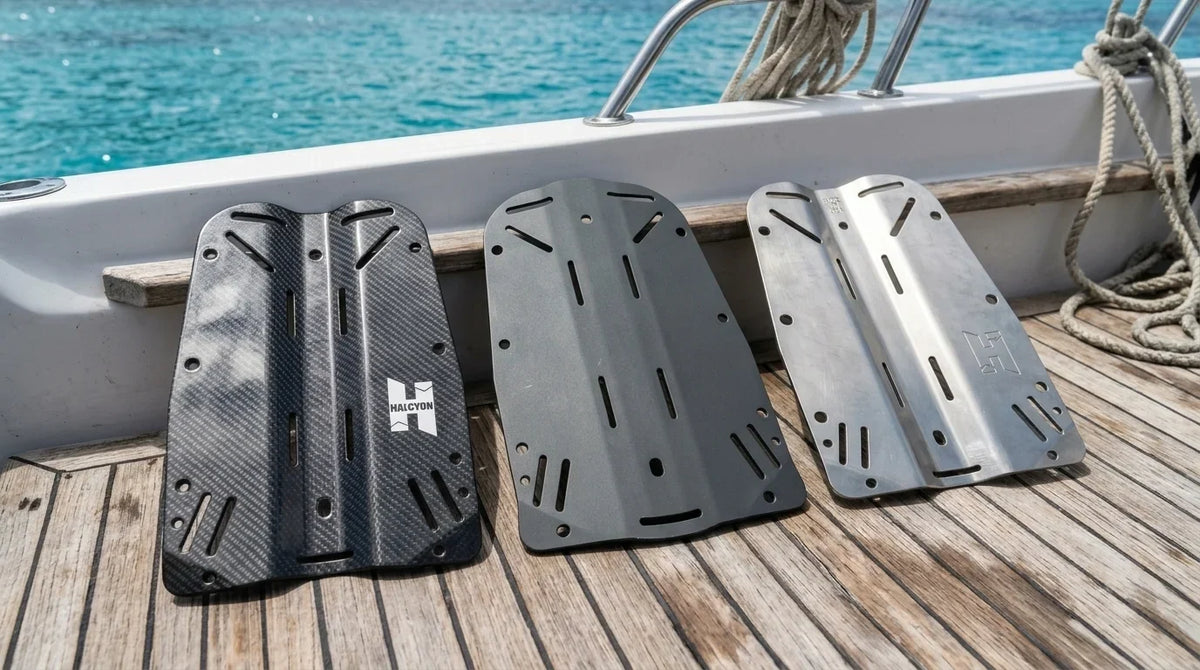
When divers first explore modular buoyancy systems, a backplate looks deceptively simple. Unlike padded jacket BCDs common in entry-level scuba classes, a backplate is a single rigid plate contoured to the human spine.
That minimalism is deliberate. The backplate forms the structural foundation of the backplate-and-wing (BP/W) system, anchoring harness webbing, supporting the wing, and securing cylinders with zero slop.
Choosing between carbon fiber, aluminum, and stainless steel is not merely about airport luggage weight. Plate material dictates in-water ballast distribution, horizontal trim, and comfort across different water temperatures and exposure suits.
Here is a practical guide to where backplates originated, how material physics operate underwater, and how to choose the right platform for your diving environment.
Where Did the Backplate Come From?
Modern divers take standardized gear for granted, but the rigid backplate was born out of necessity in north-central Florida caves during the late 1970s and 1980s.
Commercial manufacturers then produced soft backpacks, tubular frames, and horse-collar inflators. Explorers pushing deep into underground conduits found nylon backpacks shifted, plastic buckles fractured, and jackets trapped air unpredictably, causing drag-heavy trim.
In 1979, Florida cave diver Greg Flanagan bent an aluminum sheet to build the first dedicated rigid backplate. His goal was direct: bolt double cylinders securely to a solid metal spine held tightly against the diver, eliminating wobble and clutter.
During the 1980s, William "Hogarth" Main and his partners refined the harness into the Hogarthian configuration. They removed every extraneous clip, reducing the harness to a continuous loop of two-inch nylon webbing secured by a stainless steel waist buckle, minimal D-rings, and a crotch strap.
By the late 1990s, Woodville Karst Plain Project (WKPP) teams formalized these principles under the "Doing It Right" (DIR) philosophy. Pioneers, including Halcyon founder Jarrod Jablonski, standardized the dimensions: an 11-inch (28 cm) center-to-center bolt hole spacing, pressed spinal channels to nest cylinders, and radiused webbing slots preventing nylon from fraying.
That Florida cave prototype has become an international standard used across recreational reefs, shipwrecks, and deep technical expeditions.
The Physics of In-Water Buoyancy: Air Weight vs. Submerged Weight
Divers evaluating backplates often confuse luggage scale weight with underwater behavior. Under Archimedes' principle, any submerged object is buoyed up by a force equal to the weight of displaced fluid.
Because seawater has a density of roughly 1,025 kg/m³, the net negative buoyancy of a submerged plate equals its dry mass minus the weight of displaced water.
| Material | Density (approx.) | Dry Weight (Standard) | In-Water Buoyancy (Seawater) |
|---|---|---|---|
| Marine Stainless Steel (304/316) | ~7.90 g/cm³ | ~2.2 kg to 2.5 kg (4.8 to 5.5 lbs) | ~1.9 kg to 2.2 kg (4.2 to 4.8 lbs) negative |
| Hardcoated Aluminum (6061-T6) | ~2.70 g/cm³ | ~0.8 kg to 0.9 kg (1.8 to 2.0 lbs) | ~0.5 kg to 0.55 kg (1.1 to 1.2 lbs) negative |
| Pre-Preg Carbon Fiber Composite | ~1.55 g/cm³ | ~0.45 kg to 0.55 kg (1.0 to 1.2 lbs) | ~0.15 kg to 0.20 kg (0.3 to 0.4 lbs) negative |
Stainless steel loses only 13% of its dry weight in water. Aluminum loses roughly 38%, while carbon fiber loses nearly 65%, rendering it almost neutral.
The Torso Lever and Horizontal Trim
Weight placed along your body creates rotational leverage. Your lungs provide positive buoyancy in your chest, while your center of gravity rests lower near the pelvis.
Carrying all ballast on a waist belt creates a downward pivot at the hips, causing feet-down drag. A stainless steel backplate acts as active ballast: spreading two kilograms of negative weight along the spine shifts your center of gravity closer to your lungs, holding you in flat trim effortlessly.
1. Stainless Steel Backplates: The Cold-Water Workhorse
Heavy and nearly indestructible, marine-grade steel remains the original baseline for rigid backplates. Built from passivated 304 or 316 marine-grade steel, it provides structural rigidity and natural ballast.
Key Advantages
- Built-In Ballast: Supplying roughly 2 kg (4.4 lbs) of negative buoyancy along your spine removes that amount of lead from your waist belt.
- Clamping Rigidity: Under heavy manifolded steel double cylinders or rebreathers, stainless steel will not flex.
- Surface Durability: Highly resistant to gouging during wreck penetrations or cave exploration.
Considerations
- Travel Weight: Adds ~2.5 kg to checked luggage.
- Warm-Water Weighting: In tropical water with a thin wetsuit and an aluminum cylinder, a steel plate can make you negatively buoyant before adding ditchable lead.
Options in this category include the Halcyon Stainless Steel Backplate, the pre-assembled Halcyon Stainless Steel Backplate with Harness, and the Small Stainless Steel Backplate with Harness for shorter torsos.
2. Aluminum Backplates: The Versatile Middle Ground
Machined or stamped from 6061-T6 alloy, aluminum offers a versatile middle ground between heavy steel and ultralight composites.
Key Advantages
- Balanced Buoyancy: At roughly 0.5 kg negative in seawater, aluminum provides a rigid platform without excess negative ballast.
- Luggage Friendly: Weighing under 1 kg, aluminum fits easily into airline allowances.
- Single-Tank Stability: Paired with an aluminum cylinder (like an AL80), aluminum avoids front-to-back over-weighting, letting you dial in ditchable ballast.
Considerations
- Corrosion Resistance: Bare aluminum can oxidize in saltwater and develop galvanic corrosion against stainless fasteners. High-grade plates resolve this using hardcoat anodizing (Type III Military Spec), forming an impermeable ceramic surface layer.
- Additional Lead in Cold Water: Transitioning to a drysuit requires adding back the weight difference using harness or trim pockets.
Proven options include the bare Halcyon Aluminum Backplate or the Halcyon Aluminum Hardcoated Backplate with Harness (also in Small).
3. Carbon Fiber Backplates: The High-Tech Travel Specialist
Modern composite construction brings aerospace engineering to the platform. Constructed from layered carbon fiber fabric impregnated with epoxy resin and autoclaved under pressure, they deliver high torsional stiffness at minimal weight.
Key Advantages
- Ultralight for Air Travel: At approximately 500 grams, carbon fiber saves roughly 2 kg of baggage capacity compared to stainless steel.
- Corrosion Immunity: Carbon composite contains no metal. It cannot rust, oxidize, or suffer galvanic corrosion in saltwater.
- Molded Ergonomics: Molded construction allows manufacturers to integrate harness channels and slots directly into the composite body without adding metal plates.
Considerations
- Nearly Neutral Buoyancy: Contributing almost no negative ballast, all required dive weight must be carried in ditchable or trim pockets.
- Impact Sensitivity: Dropping a fully rigged system onto concrete can chip the outer resin coat along edges.
Travel divers select the Halcyon Carbon Fiber Backplate, or the Halcyon Carbon Fiber Pro with Harness (in Black and Blue) featuring molded-in Cinch channels.
Environmental Conditions: Where Material Differences Matter
Choosing a backplate material requires evaluating where and how you dive. Water density, exposure suits, and cylinder alloys directly interact with your backplate.
| Diving Environment / Profile | Stainless Steel | Hardcoated Aluminum | Carbon Fiber |
|---|---|---|---|
| Cold Water & Drysuit | Ideal (Top Choice) - Built-in ballast frees waist lead | Good - Rigid platform; requires adding lead | Fair - Light; diver carries all ballast |
| Tropical 3mm & AL80 | Caution - Heavy; risks over-weighting | Ideal - Balanced weight distribution | Ideal (Top Choice) - Safe ditchable margin |
| Twinset (Doubles) | Ideal (Top Choice) - Maximum clamping rigidity | Good - Suitable for lighter twinsets | Not Recommended - Lacks rigidity |
| Airline Travel | Heavy - Consumes ~2.5 kg baggage allowance | Versatile - Fits standard baggage limits | Ideal (Top Choice) - Ultralight (~500g) |
| Saltwater Durability | High - Marine 304/316; rinse after use | High - Hardcoat anodized against pitting | Maximum - 100% non-metallic; immune |
1. Cold Water and Drysuit Diving
Thick 7mm wetsuits or trilaminate drysuits produce substantial positive buoyancy, often requiring 8 kg to 14 kg of ballast. Placing 2.2 kg along your spine with a stainless steel backplate removes lead from your waist, relieving lower-back fatigue while maintaining level trim.
2. Tropical Waters and Single Aluminum Cylinders
In warm destinations like the Red Sea or Dubai coastal waters in summer, divers typically wear a 3mm shorty or rashguard with standard Aluminum 80 (11.1L) cylinders.
An AL80 cylinder starts roughly 0.7 kg negative when full and shifts to 1.6 kg positive as pressure drops to 500 psi.
Pairing a thin wetsuit and an AL80 with a stainless steel backplate can make a diver negatively buoyant at the start of a dive with zero weight added. Because safe diving protocol requires a ditchable weight margin, an aluminum or carbon fiber backplate provides the necessary baseline to balance your rig safely.
3. Airline Travel and Remote Logistics
Checked baggage allowances on flights generally restrict bags to 20 kg to 23 kg. A stainless steel backplate consumes over 10% of that limit. Switching to an aluminum or carbon fiber backplate saves 1.5 kg to 2.0 kg, leaving room for lights, regulators, and dive computers without excess fees.
Harness Options: Continuous Webbing vs. Quick-Adjust Systems
Your backplate functions in tandem with your harness. Two primary designs configure the system:
- Continuous One-Piece Harness: The classic Hogarthian setup, such as the Halcyon Secure Harness Webbing Kit, routes a single continuous length of stiff webbing through the plate slots. It offers zero failure points, no plastic clips, a low hydrodynamic profile, and long-term durability. Sizing is static once adjusted.
- Quick-Adjust Systems: The patented Cinch system, available as the Halcyon Cinch Harness Upgrade, lets webbing slide through lower adapter channels. Pulling the waist strap tightens the shoulder harness; pushing out on the shoulder D-rings expands the harness for easy exit. This design is ideal for divers alternating between warm-water wetsuits and thick drysuits.
Completing Your System: Wings, Adapters, and Ballast
A backplate requires a few coordinated components to build a complete diving system:
- Buoyancy Cells (Wings): For single cylinders, a donut wing like the Halcyon Eclipse Single Tank Wing provides 30 to 40 pounds of balanced lift without wrapping around the tank. For twinsets, the broader Halcyon Evolve Wing supports dual cylinders cleanly. Complete packages like the Halcyon Eclipse Pro BC System integrate the plate, wing, and harness as a matched set.
- Single Tank Adapters (STA): While many plates feature slots for cam bands, adding a rigid Single Tank Adapter provides extra stability against tank roll. For lightweight travel, the Halcyon Carbon Fiber Single Tank Adaptor offers solid cylinder lock without adding metal weight.
- Ditchable Ballast: When diving light aluminum or carbon plates, ballast must mount securely to your waist. The Halcyon Active Control Ballast (ACB) 10lb System slides onto the waist webbing, providing clean quick-release pockets along your sides.
The Verdict: Which Backplate Should You Choose?
Selecting a backplate comes down to matching material properties to your diving profile:
- Choose Stainless Steel if you dive predominantly in cold water, wear a drysuit or thick wetsuit, dive steel double cylinders, or want your backplate to supply permanent negative ballast that frees your hips from lead weights.
- Choose Hardcoated Aluminum if you want one versatile rig capable of handling local warm-water reef diving with aluminum cylinders while remaining light enough for checked airline luggage.
- Choose Carbon Fiber if you travel frequently by air, dive primarily in tropical waters with single cylinders, and value complete immunity to saltwater corrosion.
Transitioning to a backplate and wing configuration is one of the most practical steps in a diver's equipment progression. By eliminating excess padding and distributing ballast where your anatomy requires it, you achieve precise buoyancy control, streamlined horizontal trim, and stable posture on every dive.
Explore the complete selection of backplates, wings, and modular technical accessories at the Deep Dive Dubai Online Shop.
Sources and References
- Jablonski, J. (2001). Doing It Right: The Fundamentals of Better Diving. Global Underwater Explorers.
- Exley, S. (1986). Basic Cave Diving: A Blueprint for Survival. Cave Diving Section of the NSS.
- Woodville Karst Plain Project (WKPP). Equipment Configuration and History of the Hogarthian Rig. wkpp.org.
- U.S. Navy Diving Manual, Revision 7 (2016). Diving Physics: Archimedes' Principle and Buoyancy. NAVSEA.
- ASTM International (2020). Standard Specifications for 316 Stainless Steel (ASTM A240) and 6061-T6 Aluminum (ASTM B221).
- Halcyon Manufacturing (2025). Technical Specifications and Buoyancy Data for Backplate Systems. High Springs, FL.

Share:
5 World-Class Wrecks Within a 5-Hour Flight from Dubai (No Liveaboard Needed)